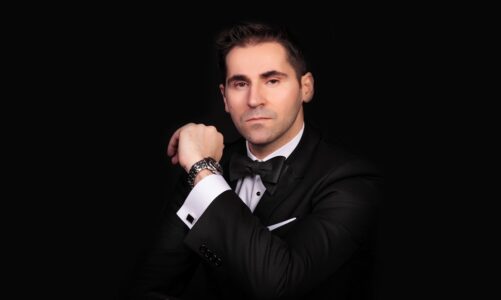

The year-long Musical Journeys project hosts elite concerts at historic and industrial heritage sites throughout the Moravian-Silesian Region. More than just a musical series, it offers a unique way to discover the region. We set off on this journey with its artistic director and manager, the clarinettist Igor Františák.
Musical Journeys are now entering their winter programme. What form did you want to give this project this year, and what links the eleven concerts from October to December?
The winter season of Musical Journeys is designed as a diverse cultural voyage, moving from intimate chamber music to grand performances by the Permoník choir and the Ondráš Folk Ensemble. Across eleven concerts from October to December, the series emphasises world-class interpretation, carefully considered programming, and a thoughtful harmony between the music and the Moravian-Silesian Region’s historic landmarks. Each evening offers a distinct atmosphere and character – Baroque music will resound in the castles thanks to Jakub Kydlíček and Vojtěch Spurný, as well as Ensemble Inégal; unusual historical instruments such as the chalumeau will be heard in churches; vocal and choral works; the Czech Philharmonic’s brass section will be joining us, and we will also hear programmes inspired by Advent and folk traditions.
Our central focus is peace, community, and a return to the season’s fundamental spirit. At the same time, we aimed to create something more profound than a conventional lineup of holiday performances. We aimed to offer diverse perspectives on sacred music and to show that it can resonate with listeners across the centuries – from Bach, Zelenka, and Vivaldi right through to contemporary composers and folk music. At the same time, Musical Journeys remains true to its core concept: we invite the audience not only to enjoy beautiful music, but also to discover interesting performers, stories and places in our region.
Not only do you organise the concerts – but you will also be performing yourself, joining soprano Karolína Levková and piano virtuoso Marek Kozák on stage. Could you tell us more about this “project of three Moravian-Silesian natives”?
The Soul of the Baroque – that is the name we have given to the project, in which each of us finds ourselves in a slightly different role from the one we are used to. Karolína sings arias by Bach and Handel, Marek takes his place at the organ, and I pick up the chalumeau – the Baroque predecessor of the clarinet. Each of these instruments has a distinct timbre, yet they complement one another naturally. With its soft, veiled, almost vocal tone, the chalumeau can blend with the human voice, engage in an equal dialogue with it, or gently enhance its expression. The organ, meanwhile, provides a harmonic foundation, but can also become an independent partner that shapes the timbre and structure of the entire composition.
The church’s acoustics are a critical factor in our performance. We must carefully balance dynamics and articulation to keep the lyrics clear and the chalumeau’s delicate tones from being lost in the organ’s power. This project is particularly rewarding because it allows us to function as a single sonic organism, where all three parts inspire each other to tell a unified story.

In December, over the course of a single week (4–9 December 2026), you will present three very different perspectives on Advent: the low brass section of the Czech Philharmonic, the Permoník choir, and the Ondráš Military Art Ensemble. What does each of these programmes offer?
Each performance offers a unique tonal colour and a special approach to celebrating the Advent season. The Low Brass Ensemble of the Czech Philharmonic is set to deliver a Christmas programme that is grand and ceremonial, yet remarkably personal. These premier Czech trombonists will present a unique programme merging sacred works from the Renaissance and Baroque eras, ancient Advent carols, Ryba’s pastoral pieces, and tunes from more modern Czech heritage. This gives the audience a chance to hear the surprisingly vibrant, gentle, and lyrical qualities of these instruments when played by world-class musicians.
Permoník will present Advent through the voices of young people. A joint performance by the youth, concert and men’s choirs will showcase the diverse forms of choral singing. The programme …and peace on earth… also carries a highly topical message. From Renaissance chant from the Louny Gradual, through Vivaldi and Bach, to the contemporary works of Ola Gjeilo, John Rutter, and Bob Chilcott, the plea for peace, hope, and reconciliation recurs time and again. When these words are sung by young people, they take on a special urgency and purity. This is not merely a beautiful choral concert, but a reminder that peace does not begin somewhere far away – it is born within each of us, in our ability to listen to one another and to be together.
Ondráš then brings folk tradition and storytelling to the conclusion of this trilogy. In Opava, the programme The Fourth Wise Man will bring together a folk instrument orchestra and a girls’ choir, commemorating Advent as a time of anticipation, journeying, and the search for deeper meaning. While these three projects differ in their line-up and musical language, they share a desire to offer a genuine experience that goes beyond the usual Christmas concert, creating a space for joy, tranquillity, and shared fellowship.
The Permoník Choir Karviná is bringing its 60th anniversary season to a close at the Musical Journeys event held at Orlová’s landmark – the Church of the Nativity of the Virgin Mary (Sunday 6 December 2026). What is your relationship with it?
My bond with Permoník is deeply personal, having evolved over time into a foundation of friendship and profound admiration. Its sixty-year legacy stands as an impressive record of persistence, dedication, and a rare talent for fostering a passion for music across different generations. More than just a world-class ensemble that secures top honours on the international stage, Permoník is a thriving community. It provides a space where youth develop both as artists and as individuals – learning the value of listening, the weight of collective responsibility, and the understanding that every single contribution is essential to the harmony of the group.
I also hold Eva Šeinerová in very high regard, as well as the work of the choir directors Martina Juríková and Karina Grimová, who have created an environment around Permoník based on professionalism, trust, and a genuine passion for music. Every time I hear the choir, I am struck not only by its technical skill and refined sound, but above all by the energy, clarity, and sincerity with which it sings.
It gives me great pleasure that Permoník also features regularly in the programme of our St Wenceslas Music Festival. It always brings something more than just perfectly rehearsed music – a sense of belonging, hope, and the belief that working together has a profound meaning. The 60th-anniversary celebrations show how many generations this choir has touched and left an indelible mark on.
How challenging is it to secure funding for the Musical Journeys whilst maintaining high artistic standards and keeping ticket prices affordable for visitors? How important is the support of public institutions, partners, and the audience itself for the project’s further development?
Securing funding for Musical Journeys is a very challenging puzzle every year. We want to invite top-class performers, create artistically innovative programmes, and bring music to smaller towns and historic venues. At the same time, we strive to keep ticket prices low and allow children under the age of fifteen to attend concerts free of charge. Without the support of major institutions such as the Czech Ministry of Culture, the Moravian-Silesian Region, and the City of Ostrava, as well as other towns, municipalities, and partners, it would not be possible to run the project to this standard.
A crucial step in its further development was creating the Friends of Musical Journeys patronage club. We want to build a community around the project comprising people who care about the future of live culture in our region and who wish to help where ticket revenue alone is insufficient. Club members become not merely donors, but true partners in our endeavour. Their support enables us to plan with greater certainty, maintain high artistic standards, and develop new programmes.
To us, sponsorship is about much more than just financial support. It is, first and foremost, a gesture of confidence and a meaningful personal tie to our mission. Each donation confirms the importance of bringing world-class music to the historic churches and castles of the Moravian-Silesian Region, fostering shared experiences that unite the community. We are, therefore, deeply grateful to every individual who decides to join our Friends’ Club. Through the commitment of these people and businesses, the project can not only endure but flourish, while preserving its accessibility, high standards, and special character.
Thank you for the interview.