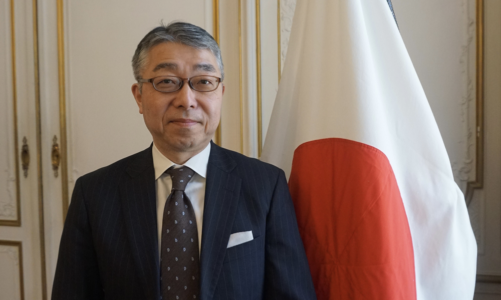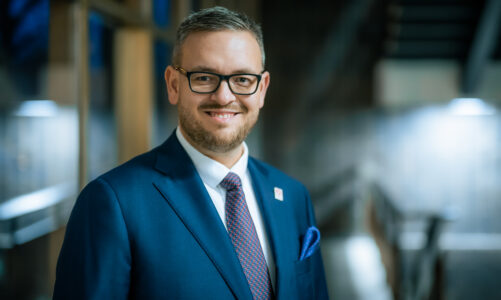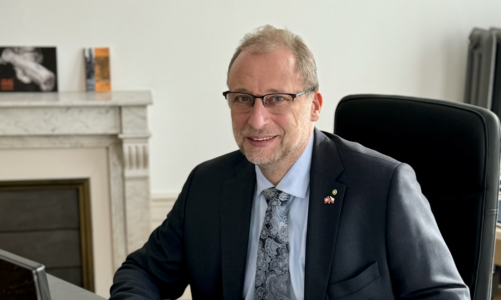

Mateusz Gniazdowski was born in Warsaw. He graduated from the Institute of Political Science at the University of Warsaw and completed his doctoral studies at the Institute of Political Science of the Slovak Academy of Sciences. Before his mission to Prague, he served nine years as Chairman of the Programme Council of the Polish-Czech Forum under the Minister of Foreign Affairs of the Republic of Poland. From 2016 to 2022, he was Deputy Director of the Centre for Eastern Studies (OSW). He began his mission as Ambassador of the Republic of Poland to the Czech Republic on 16 September 2022.
At present, the relations between the Czech Republic and the Republic of Poland are taking on a qualitatively new dimension. What do you see as the priorities of mutual cooperation today?
Following Russia’s invasion of Ukraine, the most important issues — the challenges to the security of our countries — have brought us closer together. Poland and the Czech Republic are cooperating closely both in the political sphere and on specific issues related to humanitarian aid and the supply of weapons and military equipment to Ukraine, which is mainly carried out across Polish territory. We are among the group of countries that are sending the most weapons to Ukraine, including heavy military equipment, and we are also among the countries that have received the most refugees. The Russian invasion is ongoing, and the survival of an independent Ukraine and the ousting of the aggressor is in the vital interests of our countries and of the entire West. Working together in support of Ukraine is a priority. This also applies to the preparations for the reconstruction process in that country because the synergy of our activities can help us to face the competition together. In economic cooperation, certain key issues also directly affect the security of both countries: building complete independence from Russian oil and gas, and the transformation of the electricity sector. Orlen Unipetrol plays a vital role in the issue of oil and ensuring its availability in the Czech market. Regarding gas, negotiations are underway on the Stork II gas connection, which would enable the real diversification of gas supplies to the Czech Republic, using LNG supplies from terminals in the Baltic Sea. After years of illusions about reaping the benefits of Nord Stream, there is the possibility of a connection that is not just an empty reserve pipeline but a financially justified step towards strengthening the gas market in our region and its energy security. This requires binding declarations.
The most important thing is our trade relations, which are developing dynamically following the pandemic period and despite the ongoing war. Our total trade turnover reached EUR 33.8 billion for the first time in history. The Czech Republic is Poland’s second biggest export partner, and exports to the Czech Republic reached EUR 22.7 billion. Poland is strengthening its position as the Czech Republic’s second largest trading partner after Germany in the EU. However trade growth is lagging behind the development of infrastructure connections. Many gaps in this area need to be filled. I also consider the issue of broad cross-border cooperation to be a priority. Russia’s invasion of Ukraine began three weeks after the signing of the agreement concerning the cross-border consequences of mining in the Turów mine. Before that, this cooperation had been severely complicated by pandemic measures. Thirty years of successful cross-border cooperation have been overshadowed. And this cooperation should be recognised and developed.

Many companies with Polish capital operate in the Czech Republic. What investment opportunities does Poland offer Czech companies?
The outlook for Poland remains positive. This can be attributed to several factors, including Poland’s stable political and economic environment, a growing talent pool, and business-friendly policies. In addition, Poland continues to attract investment in key sectors such as technology and manufacturing. Poland’s educated and highly skilled workforce makes it an attractive destination for businesses looking to expand in Europe. Our country is taking advantage of the digital transformation to remain competitive. This includes investing in e-commerce, mobile apps and other digital solutions to reach customers and streamline processes. In addition, since September 2018, companies have had the possibility to apply for tax exemptions throughout Poland, not just in Special Economic Zones (SEZ) as previously. The Ministry of Development and Technology announced that 2,015 decisions had been issued by the end of February under the Polish Sphere of Investment (PSI) to support new investments, which are responsible for the creation of 10,654 jobs. Their declared value is close to EUR 21 billion. This can also be an incentive for Czech companies to be more active and to look for suitable areas and business partners. Not all opportunities are being sufficiently exploited. Attention should also be drawn to the largest economic event in Central Europe, the European Economic Congress in Katowice. The city is located an hour away from Ostrava by motorway. This year, it will take place from 24 to 26 April.
The two nations need to get to know each other more, and culture and tourism can be a mediator. How does Poland present itself to the Czechs in these areas?
We are pleased that more and more Czechs are discovering the beauty of Poland, not only in the border region but also in the beautiful Polish cities, on the Baltic Sea or the Masurian Lakes. The road infrastructure in Poland has improved significantly, rail connections are steadily improving, and the network of air connections by Polish and foreign carriers is also growing. I am convinced that this upward trend of visitors to Poland will continue thanks to the opening of the long-awaited office of the Polish Tourist Organisation in Prague. The promotion of Polish culture is handled by the Polish Institute. It is one of the most active foreign institutions in Prague and also one of the most dynamic Polish institutions abroad. Czechs can encounter authentic Polish culture in the Těšín region. The phenomenon of Polishness on the Czech side of Silesia is a cultural treasure whose role in the development of Polish-Czech cooperation should be appreciated.
Thank you for the interview.