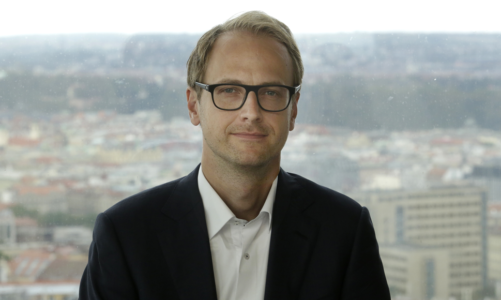

Ing. Kateřina Kupková is the Chairwoman of the Board of Directors and CEO of Lenzing Biocel Paskov. She has held several managerial positions in the company. She manages the plant, which is known for its environmentally friendly production of a material called pulp. She is a member of the praesidium of the Association of the Czech Pulp and Paper Industry as well as the Association of Forestry and Wood Processing Companies, for which she is running for Vice-President of the Confederation of Industry and Transport of the Czech Republic.
This year, Lenzing Biocel Paskov will celebrate 40 years since the construction of the plant. What are the milestones of the company’s history and its vision for the future?
The history of our plant follows the long tradition of pulp production in the paper mills of Vratimov, where it was produced for almost 100 years. In 1983, the entire production was moved to a newly built plant in Paskov. The production was moved mainly because that particular pulp mill no longer met the ecological limits and did not meet the capacity requirements. In the same year, a large number of employees from the paper mills in Vratimov moved to Paskov. And some of the employees who still work there today certainly remember the move.
The production of paper pulp continued for another 30 years after the move from Vratimov to Paskov. It was not until the arrival of the Austrian Lenzing Group in 2010 that a huge investment in technology and transformation of the production programme began. In 2011, we started to produce viscose pulp, which is further processed into viscose fibre for the textile industry and nonwoven fabrics, which today can be found under our clothing brands TENCEL ™, ECOVERO™, LENZING™, and in nonwoven fabrics under the name VEOCEL™.
Our basic sustainable raw material for the production of viscose pulp is spruce wood. We use low-quality wood, i.e. wood from controlled forestry using the stand method and sawmill residues. During production, we minimise the amount of waste products generated, consuming almost everything. This makes us a sustainable biorefinery with closed-loop production. We are almost entirely energy self-sufficient. Our carbon footprint in pulp production is very low. We use 98% of our own produced green energy for the production process.
The Lenzing Group is one of the leaders in its field, and through our investments in the construction of new plants and lines in Brazil and Thailand, we have become the world’s leading supplier of speciality fibres for the textile industry and the production of nonwoven fibres.

Lenzing Biocel Paskov has been a strong and stable employer in the Moravian-Silesian Region for 40 years. What are your specific activities in different areas to support the region’s development?
Throughout its history, Lenzing Biocel Paskov has always relied on close cooperation with surrounding towns and villages, supporting activities for the development of the Moravian-Silesian Region in various areas. The proof of our stability as an employer is our employees themselves, who have spent their entire professional careers in the company. As a result, our company operates with minimal employee turnover. For this reason, our activities towards people are not limited to the environment and facilities of the production plant. We are aware of our cohesion with the surrounding cities, towns and villages, whose inhabitants make up a significant proportion of our employees and colleagues. That is why we also support projects that develop social, sport, cultural and educational areas in the region because we are among the conscientious and sustainable producers who are actively involved in environmental protection issues and, in close cooperation with the Moravian-Silesian Region, we are involved in the rescue and restoration of nature in the region.
You were awarded the title of Manager of the Year 2020. What should be the role of a woman manager nowadays?
I do not think it makes any difference whether the manager is a man or a woman. The roles and tasks they have to perform are the same. However, they differ in their approach to dealing with different situations. I perceive that female managers put more empathy into their decision-making, sometimes also emotion. They are not always as assertive as male managers. This does not mean lower performance or less drive by any means. In my experience, the view of women in management is gradually changing. The fact that women are appearing in senior management positions and running manufacturing or technology companies is not as surprising today as it was a few years ago. However, there are still not enough of them, especially in industrial companies. That is why I believe that it is important for women managers to also appear in the management of companies, but also in high positions in public administration or politics.
You are running for the position of Vice President of the Confederation of Industry and Transport. How do you want to help Czech industry?
I have worked in the industry for over 20 years, and I am confident that I have enough experience to contribute to the work of the Confederation of Industry. I am also a member of the Board of the Association of the Czech Pulp and Paper Industry in addition to the Association of Forestry and Wood Processing Companies. Industrial companies are currently facing many challenges. I believe that the Confederation of Industry is the right platform that must support an appropriate business environment and communicate very intensively, especially with political representation. It is absolutely essential that lawmakers have an idea of how companies are doing business today and how difficult it is to live in companies today. There are too many issues that are now at the forefront: the energy crisis, high inflation, the global economic recession, etc. From my point of view, it is also important, for example, how long permit procedures take, the enormous bureaucratic burden that is being placed on companies today, and so on. The current government should be much more interested in Czech industry because it is a fundamental pillar of the further development of our society.
Thank you for the interview.