
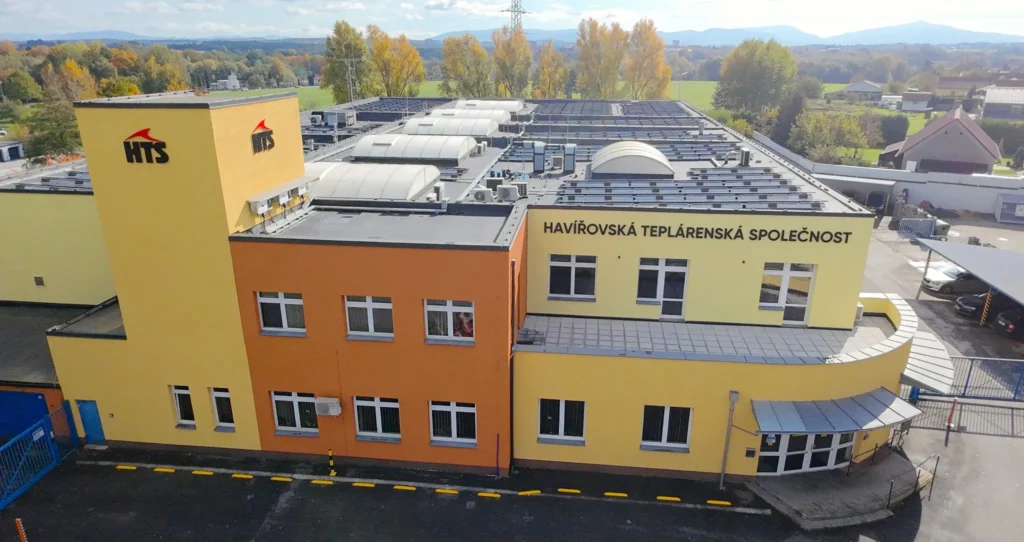
he heating industry in the Czech Republic is on the brink of significant change. Pressures to cut greenhouse gas emissions, the influence of emission allowance prices, geopolitical instability, and technological advances are pushing heating system operators to explore new directions. Centralised heat supply (CZT) is often mistakenly seen as an outdated relic. However, Ladislav Moravec, who has devoted his career to the energy sector and is the director of Havířovská teplárenská společnost, a.s., argues the opposite. He believes that an optimised centralised heat supply system could be a key pillar of a decarbonised energy future.
What does the term “heating industry” actually refer to?
I view district heating in the Czech Republic as a part of the energy sector that has often been overlooked by legislators, despite being as essential as electricity and water for basic thermal comfort. Traditionally, it involves a centralised supply system, historically from heating plants, but now mainly from plants that have implemented various environmental measures. For consumers, it is a carefree service, eliminating concerns about fuel pur chases, equipment checks, breakdowns, or investments in boiler rooms or heat pumps. They can simply adjust their radiators to reach a comfortable temperature.
What are the specific characteristics of district heating in the Czech Republic?
The main characteristic is the widespread expansion of district heating systems, tied to the Czech Republic’s industrial history and coal-mining tradition, as coal was a key fuel for these systems for many decades. Another important factor was urbanisation in large cities, where dense housing developments were not suitable for numerous local heating systems. These elements, combined, fostered the construction of extensive district heating networks. In a broader European context, highly developed systems also exist in Germany, most Scandinavian countries, such as Finland, Denmark, and Sweden, as well as Iceland. Many other countries wish to develop district heating, but it is a challenging task administratively, technically, and economically.
Can we then consider district heating systems to be a valuable as set of the Czech heating industry?
It is undoubtedly the cornerstone of Czech heating and a legacy from our ancestors, very difficult to replicate today, especially in densely populated areas. However, only district heating systems that are well maintained by operators and that invest in development and ongoing reconstruction using the best available technologies can truly be considered a valuable asset. Objectively, there are also downsides. A major disadvantage is the transport distance of the heat transfer medium from the source to the consumer, which has an unpleasant physical property resulting from the laws of thermodynamics. The percentage of heat loss naturally increases with the length of the primary network’s heat supply pipes and the density of the secondary network. Last but not least, central sources are still overwhelmingly fossil-based and must therefore undergo a massive transformation of their fuel base and the technologies used, with the aim of achieving maximum possible decarbonisation.
What are the major risks for distribution system operators?
The biggest threat to distribution systems is the potential collapse of the network. It is crucial to understand that these systems are designed for overall efficiency, and any division inherently reduces this. Risks mainly arise from efforts by owners’ associations and consumers to disconnect and switch to independent sources, such as heat pumps or gas boilers. This effectively reverts to local heating systems, albeit with modern technology, often driven by misguided environmental or economic motives. The greatest danger lies in breaking the system into smaller units, potentially installing a heat source for each house or even each residential unit.
Is there a universal method to optimise district heating systems?
Reducing distribution losses and diversifying sources is crucial. Diversifying the fuel mix reduces the risks of reliance on a single fuel and its volatility. Each system is unique, often having developed organically, so there is no one-size-fits-all solution. The path forward involves using alternative thermal energy sources through strategic decentralisation within district heating systems. An ideal solution combines a primary, eco-friendly, multi-fuel source with cogeneration units that bring energy production closer to consumption.
How do you intend to tackle this issue in Havířov?
A major asset of the city of Havířov is its extensive district heating distribution system, which covers all its cadastral areas and is considered efficient. Thanks to ongoing modernisation, it is also in very good technical condition. Black coal has long been the dominant fuel, so it is primarily necessary to switch to a multi-fuel, ideally low-carbon source from our primary supplier. However, I consider this to be an important but generic step, conditional on the necessary transition away from coal. What I see as truly groundbreaking is partial systemic decentralisation. A major advantage for the city of Havířov is its extensive district heating distribution system, which spans all cadastral areas and is considered efficient. Thanks to ongoing upgrades, it is in excellent technical condition. Historically, black coal has been the main fuel, so the key is to transition to a multi-fuel, ideally low-carbon source from our primary supplier. While I see this as a crucial but standard step toward moving away from coal, the truly groundbreaking approach is partial systemic decentralisation.
Why do you consider systemic decentralisation to be a ground breaking step?
Primarily because we are breaking down the long-standing monopoly and involving all stakeholders. Havířov’s district heating system will no longerrely on a single dominant source and primary supplier; it will be enhanced by a second thermal energy supplier via a cogeneration unit integrated into the system. Initially, we will proceed cautiously with a pilot project: one cogeneration unit will be installed at our largest transfer station, and its economic benefits will be tested in real operation. I believe the combination of multiple fuel sources and smaller cogeneration units will leverage the advantages of both and ensure the diversification of sources. The evaluation of this pilot project could illustrate a possible method to revolutionize the heating industry, extending beyond just Havířov.


