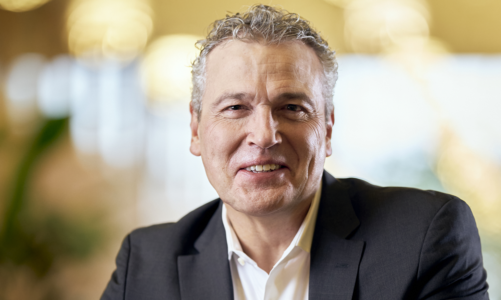

Kamil Čermák
Has worked as a reporter and presenter at Czech Television. Since 2016, he has been the CEO of ČEZ ESCO, which brings together ČEZ companies from the modern energy sector and has almost 2,000 employees. He also serves as the President of the Czech Institute of Directors (CIOD). He is the Chairman of the Board of Directors of the National Energy Efficiency Centre. And he received an award in the national Smart City Personality of the Year 2018 competition.
ČEZ ESCO is a leader in effi cient, economical and environmentally friendly energy solutions. Its activities are also
focused on local government and cultural institutions. And it is the energy-saving solution for buildings that are
national monuments that can mean new energy for Czech culture. The historical building of the National Theatre
can be an example of this.
The pandemic has had a significant impact on business, but above all, on Czech culture. How do you see its future?
I love books, music, film, theatre. My mother worked in culture all her life, so I practically grew up in the theatre in Olomouc. Thanks to my mother, I got to know North Moravian bards like Pavel Dostál, Jarek Nohavica, Karel Plíhal and other artists from a very young age. I have many friends among musicians, writers and filmmakers. So it has affected me personally. As far as ČEZ ESCO is concerned, since many of our customers are cities and municipalities, we have perceived this problem as a business issue. The pandemic has affected budgets; new projects have been postponed, investments have not been made, and, of course, many cultural and social events have had to be moved.
We have energy-saving projects, and we run power in theatres. These convention halls suddenly emptied, so we addressed those issues directly. But we see another interesting trend in the context of the pandemic. The situation has forced councillors to look for opportunities to save municipal money. And this is where the opportunity opens up for energy savings, the use of renewable energy, lighting upgrades and other solutions to optimise energy systems. This is where we can off er our experience to cities but also to other cultural institutions. Last year, our EPC services helped Czech cities and other institutions save almost CZK 250 million. Even though investments in our customers may have been delayed, we see that they are increasingly interested in environmentally friendly and energysaving solutions.
Are there any cost-saving projects in culture in particular?
Of course. We have a number of energy projects right in the biggest cultural institutions. The flagship was our project at the National Theatre, which we operated for ten years and then handed over to our customer. In 10 years, the theatre saved CZK 93 million in energy costs and eliminated 24,000 tonnes of CO2 emissions. Doing energy upgrades in such important and listed buildings is of course a challenge, but it can be done. The theatre is now run as a smart building, cooled and heated by water from the adjacent Vltava River, and has photovoltaic panels on the roof that are sensitively incorporated so as not to disturb the city skyline. We have similar projects in the Rudolfinum, the Estates Theatre, the State Opera House, the Prague Congress Centre… The former “Pakul” saves over CZK 20 million a year. But we also have energy efficiency projects in culture and education in the regions — in Klatovy, Moravian-Silesian Region and Pardubice.
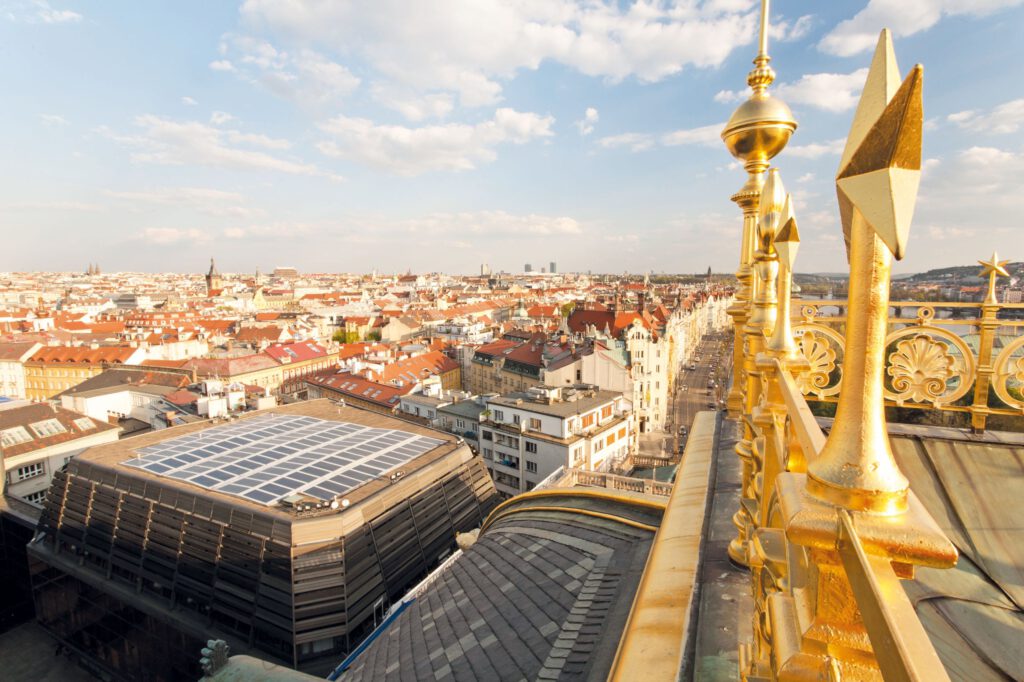
As part of the announcement of the approval of the National Recovery Plan of the Czech Republic, the President of the uropean Commission Ursula von der Leyen visited the project at the State Opera House, where the ČEZ ESCO (Energy Service COmpany) Group has started a comprehensive energy savings project. How did she like this project?
It is a reward for our work and a recognition of the quality of our designers and engineers when the Czech Republic can boast of our project during the visit of such an important individual. Of course, energy retrofitting of historic and listed buildings is also being addressed in Europe. When they were being built a hundred or two hundred years ago, their operation with regard to the climate footprint was, of course, not addressed. There were other priorities. And if Europe wants to be climate neutral, it will have to modernise many historic buildings. The European Commission’s Fit for 55 package now proposes that countries should be obliged to renovate 3% of public buildings each year to make them more energy efficient and use as much renewable energy as possible. Since 2009, the project at the State Opera House has saved CZK 52 million and eliminated 17,500 tonnes of CO2 emissions, equivalent to about a week’s operation of a conventional coal-fi red power station.
It can be said that such projects can mean new energy for Czech culture. What is ČEZ ESCO’s relationship to supporting culture?
As I have already said, I myself have a very close relationship to culture, and the entire ČEZ Group has long supported various cultural events throughout the Czech Republic. Especially where we operate (local festivals, concerts, theatre events). Culture keeps our traditions alive, tells us who we are and binds us together as a nation.
Thank you for the interview.