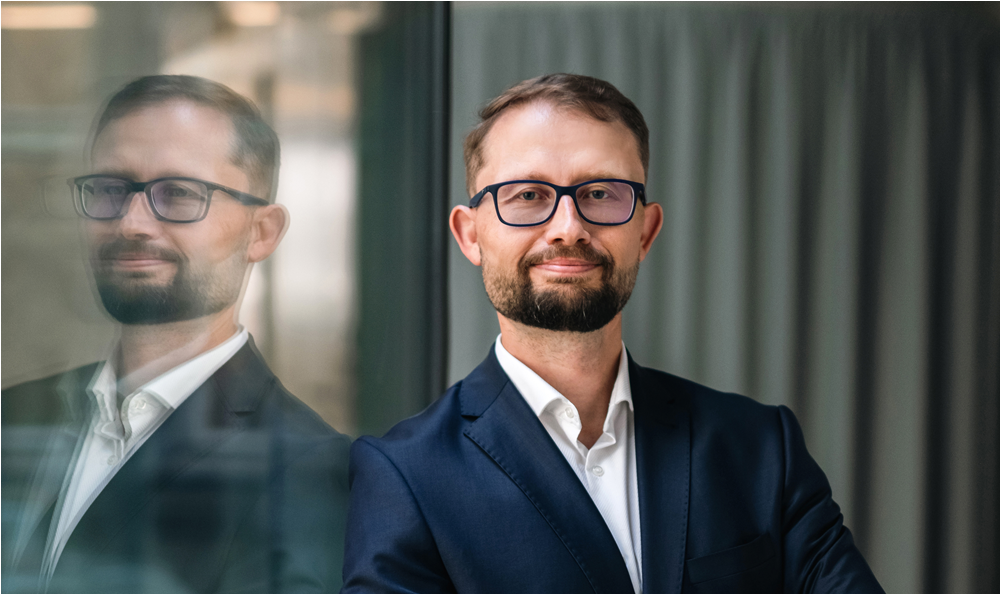
As Regional Development Director at Panattoni, Jan Andrejco is responsible for identifying sites for industrial development, acquisition strategy, and designing development concepts. In recent years, his big topic of interest has been revitalising brownfield sites. He is a member of the Board of Directors of the Czech Green Building Council and is a great supporter of the topic of brownfields.
You are one of the most active industrial real estate developers in the Czech Republic. What are the current trends in this area?
The strongest trend is clearly sustainability. Panattoni is a leader in this area on the Czech industrial development market. We have the largest number of buildings in our portfolio that have received the international BREEAM New Construction certification, both in terms of the number of halls and their floor area. In terms of numbers, we currently have 1.5 million square metres of buildings that have received the award or are in the process of certification. Green solutions are in high demand from our clients. Large international companies have carbon neutrality targets, and, of course, manufacturing and logistics are areas where emissions reduction is essential.
Does the desire for sustainable solutions only apply to large multinational companies or also to domestic companies?
In the Czech Republic, we are waiting a bit to see what regulation will come from the European Union. But the sooner domestic companies focus on this area, the better for them. When multinational companies “clean up” their own production and logistics, they will also address the carbon footprint of their supply chains, of which Czech companies are often a part. Those who are behind the times will have no one to supply to. It is important to mention that the significant drivers of the so-called green transformation are not only regulators but also, for example, banking houses and funds providing financing and, last but not least, HR departments. For the younger generation in the West, it is important to work for responsible companies, and this trend will undoubtedly come to us as well.
Your speciality is the use of brownfields. Have you successfully attracted investors for these sites in Prague and Central Bohemia?
We like to bring life back to areas that have an industrial tradition. Even if construction on brownfields is more technologically demanding, for example, because of the ecological burden, it makes sense. It is a specific feature of Prague and other large cities that the original industrial areas are now logically giving way to residential or mixeduse development. In Prague alone, we can name places such as Vysočany, Waltrovka, Smíchov, Nusle, or the soon-to-be Koh-i-noor in Vršovice. In total, 600 hectares of formerly industrial areas have recently disappeared in Prague alone. However, we are working on projects in Prague’s Kovošrot or the former Poldi Kladno site. In general, there is a significant demand for locations in Prague and its surroundings from investors and tenants, and the vacancy rate is basically zero. However, the number of sites for constructing modern industrial complexes is minimal.
Sustainability assessment and transport links to the zone are now a necessity. Are you succeeding in getting rail connections as well?
The environmental performance of transport in the construction and operation of buildings is a very important criterion for the BREEAM New Construction certification. Rail connectivity is thus a significant criterion when looking for sites for construction. Due to the industrial tradition, such a connection is often an advantage for brownfield sites. However, we are also focusing on building facilities for cycling or charging the infrastructure for electric vehicles, so that not only goods but also employees have the option of sustainable transport.
Thank you for the interview.