
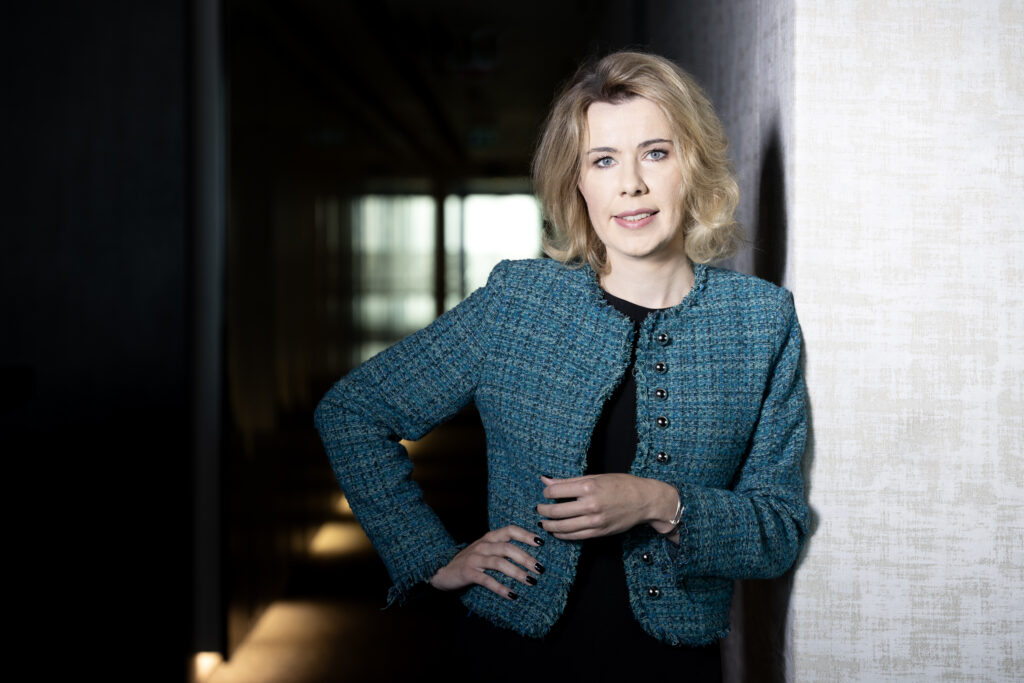
Markéta Flanderková is a prominent Czech specialist in asset management. As a partner at PORTOS and CCS PREMIUM TRUST, she frequently provides guidance to both Czech and international clients on safeguarding and transferring family assets. In the interview, she discusses the latest trends in wealth management and highlights the benefits of both Czech and international practice.
Trust funds have been available in the Czech Republic for roughly a decade. What is the current level of interest in them?
Interest in trusts and endowment funds is consistently rising. This trend is partly driven by the current period of intergenerational asset and business transfers. Entrepreneurs who launched their businesses in the 1990s are now handing them down to their heirs. Clients are also gaining greater awareness of these types of products. Instead of seeking ad hoc solutions, they are adopting a strategic approach. They aim to safeguard their assets by diversifying risks and optimising structural setups / setting up legal structures. Clients now view asset management as a comprehensive process, similar to what is common in other Western countries.
How has the Czech public’s perception of them evolved over time?
I believe the change is particularly evident in that, previously, clients would approach us with general questions about how to address their situation. Nowadays, they are generally aware of trusts and various international options. As a result, they approach us with more specific intentions and request advice on these particular instruments.
What is the lawyer’s role in establishing them?
While legal expertise is a crucial base, asset management demands a comprehensive approach. It is insufficient to set up a fund’s structure solely from a legal standpoint; collaboration with tax advisors and economists is crucial for optimal results. Psychology often plays a role as well, especially in family cases. Family relationships aren’t built on numbers or formal structures, so it’s important to understand how the family operates – their rules, communication style, and expectations – and tailor the fund accordingly.
Since creating a fund structure is often accompanied by the intergenerational transfer of company leadership or a shift to professional management, it is essential that this structure is properly set up within the company or holding that is being transferred into the fund. This includes implementing effective governance and control mechanisms, setting up reporting processes and compliance systems, and clearly defining responsibilities for each role within the business side of the founder’s assets.
Could a poorly established trust pose legal risks?
Generally, a trust fund is not considered a risky tool, but if it is set up by someone inexperienced, it can potentially endanger the settlor, the beneficiaries, and even the trustees.
The problem would also arise if there were an intention to misuse the fund’s structure to commit a criminal offence, just as would be the case if companies were used for an illegal purpose. In such a case, criminal liability could, of course, be imposed — including on the founder or the trustee.
How do you maintain a balance between transparency and privacy when establishing ownership structures?
The Czech Republic has quite transparent registries where a wide range of personal and property-related information can be easily accessed. This can be avoided in the case of fund structures. However, transparency is maintained. In 2018, a register of trusts was introduced, which improved transparency and formally documented their existence. Similarly, endowment funds are also subject to official registration. While a common criticism at the outset was the lack of transparency and clarity regarding assets transferred into trusts, this information is now accessible to the relevant authorities – but not to the general public. Information about the settlor, beneficiaries, and assets placed in the fund remains hidden from the public record, which, in my opinion, is definitely the right approach given the purpose of establishing a trust for private asset management. In some Western countries, privacy protection is even higher.
Therefore, clients often use trusts, endowment funds, or foreign structures to safeguard their privacy, hich is another reason why such fund structures are established.
What foreign options can you provide for your clients?
We provide various proven solutions, such as entities in Luxembourg, Jersey, and the United Arab Emirates. However, we typically recommend Liechtenstein foundations, which offer a high degree of legal certainty, tradition, and accessibility within Europe. These foundations are ideal for clients who value anonymity, maximum asset protection, and stability. Since Liechtenstein is not part of the EU, it offers enhanced protection against unauthorised creditors. Additionally, it features a highly sophisticated legal framework for wealth management, supported by centuries of tradition and a strong international reputation.
How challenging is it for foreign clients to establish a foundation in Liechtenstein?
It always depends on the individual client – such as the complexity of their family situation, what they aim to achieve through the foundation, and how complex their asset structure needs to be. Establishing the foundation itself is not necessarily complicated, but the goal is to tailor it precisely to fit the family and the client’s specific circumstances. It is always a highly individualised process.
In May, you were the sole representative from the Czech Republic at the esteemed Cambridge Forum conference held in Paris. Could you share some insights about this event with our readers?
It is not a conference in the usual sense of the word, but rather a closed forum of selected experts from around the world. Each country is represented by only a limited number of professionals – this time, there were thirty of us from various jurisdictions. We discuss recent developments, legislative changes, trends, and landmark case law. It is an opportunity for an expert exchange of insights and experience across legal systems. I represent the Czech Republic at the Cambridge Forum, together with my colleague Jakub Hollmann, who is a member of a different section.
How can someone gain entry into this exclusive community?
Typically, you are only considered for inclusion if an existing member recommends you. In our case, it was our collaboration with colleagues from Liechtenstein that opened the door. Liechtenstein has a robust tradition in asset management and is a consistent, long-term participant in such platforms. This cooperation enabled us to gain key expertise in wealth management and asset structures, along with valuable exposure to the international context.
How is the representation of women at the event?
Men are in the majority, but the ratio is approximately 60:40, which means there is a substantial representation of women. Overall, the presence of women in the legal profession is typically greater abroad than in the Czech Republic, although we are gradually closing that gap.
What advice would you offer to young female lawyers to help them enter the field successfully as you have?
You should always keep learning and progressing, as standing still equates to moving backwards.
Thank you for the interview.


